
Dev log

News from the making of Huey, a color-mixing adventure platformer for the Game Boy Advance. Big moments get a post. Everything else goes in the changelog at the bottom.

Made by Mitchell Ray at Meteor Labs, Longmont, Colorado

Huey is on his way to the GBA!

About 31% of the way to release

  1. ConceptDone
  2. ExplorationDone
  3. Build and testAbout 25%
  4. PolishNext
  5. ReleaseLater

My estimate, based on the work left to build Huey. This will update automatically as things get done. Updated November 25, 2026.

EnemiesDesign

Meet the bugs

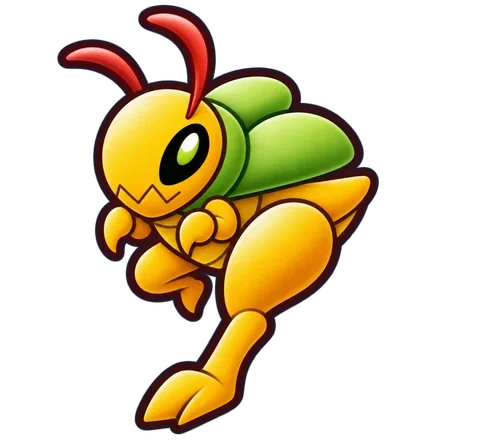
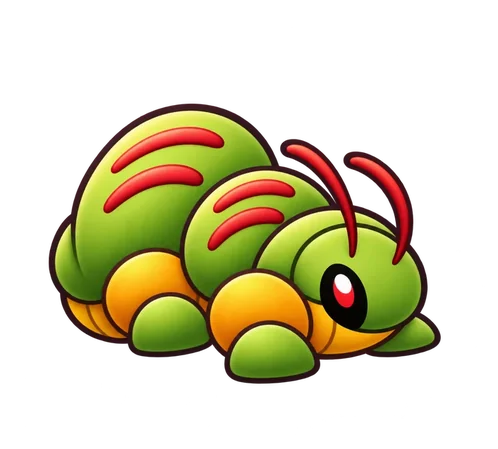
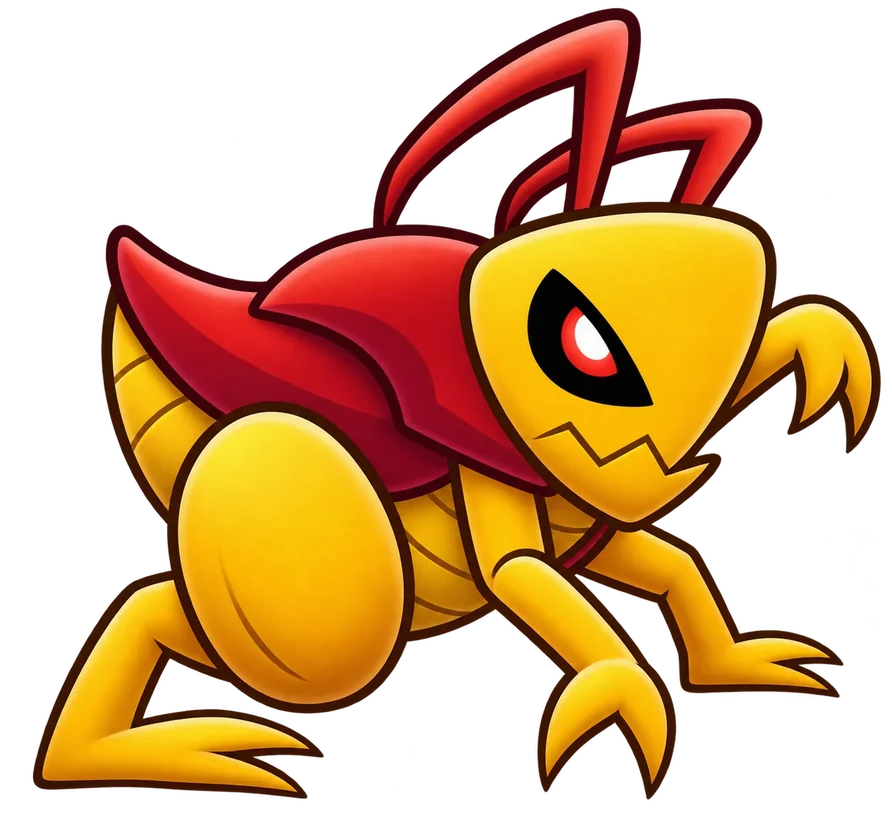
Every enemy in Huey is a bug. Seven originals travel the whole game, and each biome adds a few of its own.

Every enemy in Huey is a bug, and today I finished planning the full cast for Huey 2.0. The seven original bugs are the core of it. They show up all through the game in new combinations, and each biome adds a few newer bugs that fit its setting. I also raised the limits so levels can mix things up more: up to six bug types per biome, four per level and three per room.

Small bugs that you can stomp can also be eaten and spat back out as a projectile. I've been calling it Stomp & shoot. Armored bugs can't be eaten, so you have to find another way past them.

The bigger originals have a special job. Once per level, one of them waits on the main path as a single tough enemy you have to outsmart. That might be a Dashopper with a long runway to charge down at you, or a Duntle sitting at the top of a slope, ready to roll its ball.

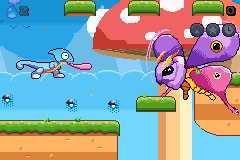
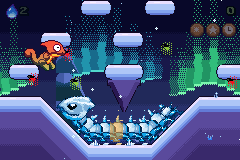
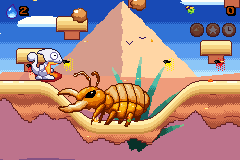
A yellow and red mantis-like bug with clawsA red ant bug with curved pincersA yellow cricket bug with a green shellA round green grub bug with red stripesA round scarab beetle bugA small striped wasp bug
News

Find Huey online

Huey now has a home on YouTube, Bluesky, X and itch.io, all under @hueychameleon.

I set up Huey's social accounts today. You can find the game as @hueychameleon on YouTube, Bluesky and X, and I'm building out the itch.io page where the demo will live. Every profile uses the same one-line description: a color-mixing platformer for the Game Boy Advance, playable on original hardware.

The website is close too. It has a press kit with screenshots, clips and art for anyone writing about the game, and this dev log lives there now. I'll post here whenever something worth showing lands in the game, and the changelog at the bottom covers the smaller day-to-day changes.

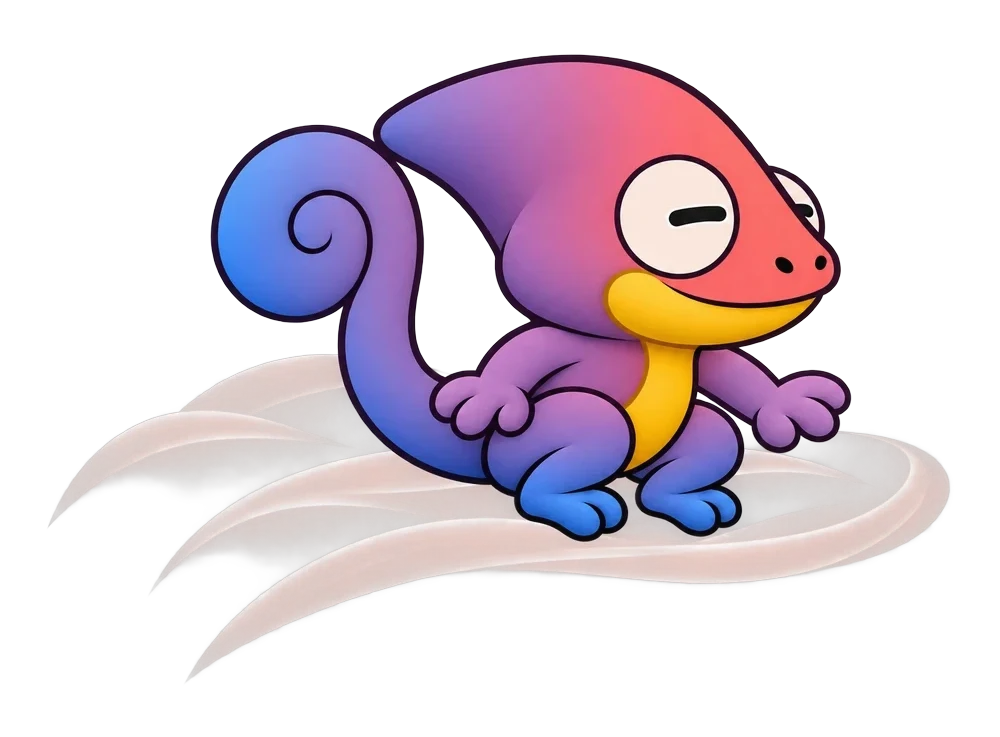
The Huey the Chameleon logo
Gameplay

New controls, locked in

After a week of testing on a Game Boy Advance, the new control scheme is final.

To settle the controls I built a move lab, a test room where I can try every power side by side. I played it on my Game Boy Advance until everything felt right, and the scheme is now locked. A jumps, and pressing A again in the air does your color's air move. R attacks, B fires the tongue and L spits.

Each color powers up one of Huey's four verbs: run, jump, fight or float. Mixing two colors gives you both moves. Each button works once per jump, so you can chain a dash into an air jump. That chaining turned out to be too much fun to give up.

Dashes and dives can be steered a little mid-move, and a small ledge assist helps you land the jumps you meant to make. The tongue swing stays as gray Huey's own way to move fast before he has any colors.

Green Huey air jumps off a ring of windRed Huey fires an Ember ShotBlue Huey bounces on a bubble
Yellow Huey dashes forward in a crackle of lightning
HardwareArt

How Huey wears two colors at once

Huey's body now blends both of his colors from top to bottom, using a trick built into the GBA's screen hardware.

This is my favorite thing I've built for the game so far. When Huey eats two colors, his body shows both, with the color he ate first on top blending smoothly into the second one below. One look tells you what he's carrying and which color a hit will take away.

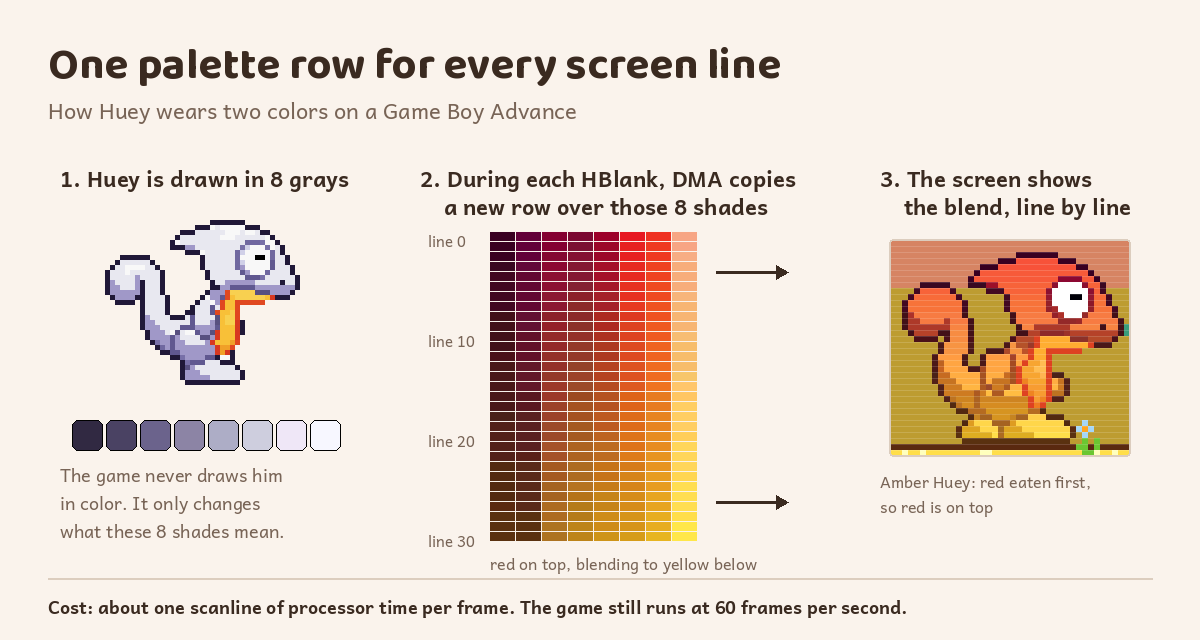
There's no extra art behind it. A GBA sprite gets its colors from a 16-color palette, and the screen is drawn one horizontal line at a time. Between lines there's a short pause called HBlank. I lined up all of Huey's gray shades next to each other in his palette, then set one of the GBA's DMA channels to rewrite just those shades during every HBlank. Each line of Huey gets its own blend, so the colors flow from his crest down to his feet.

The processor barely has to do anything. The blend table only gets rebuilt when Huey's colors change, and the DMA copies one small row of colors per line by itself. The whole effect costs about one scanline per frame, and the game still holds 60 frames per second.

To free up that DMA channel, I kept Huey's sound effects on the GBA's classic square-wave channels instead of sampled audio. That suits the sound of the game anyway.

Huey's sprite cycles through gray, red, a red-to-yellow Amber blend, then blue, teal, purple, lime and copper blendsAmber Huey after eating red first: red on top, yellow belowAmber Huey after eating yellow first: yellow on top, red belowAfter a hit, Huey keeps only the color on topAmber Huey standing on a snowy peak
Diagram: Huey's sprite is drawn in 8 grays; during each HBlank, DMA copies a new row of 8 colors over those grays, red at the top line blending to yellow by line 30; the screen shows Amber Huey red on top and yellow below. Cost: about one scanline of processor time per frame.
Hardware

Fitting a big adventure on a small cartridge

I cut about 3.1 MB from the game without changing how a single level looks or plays.

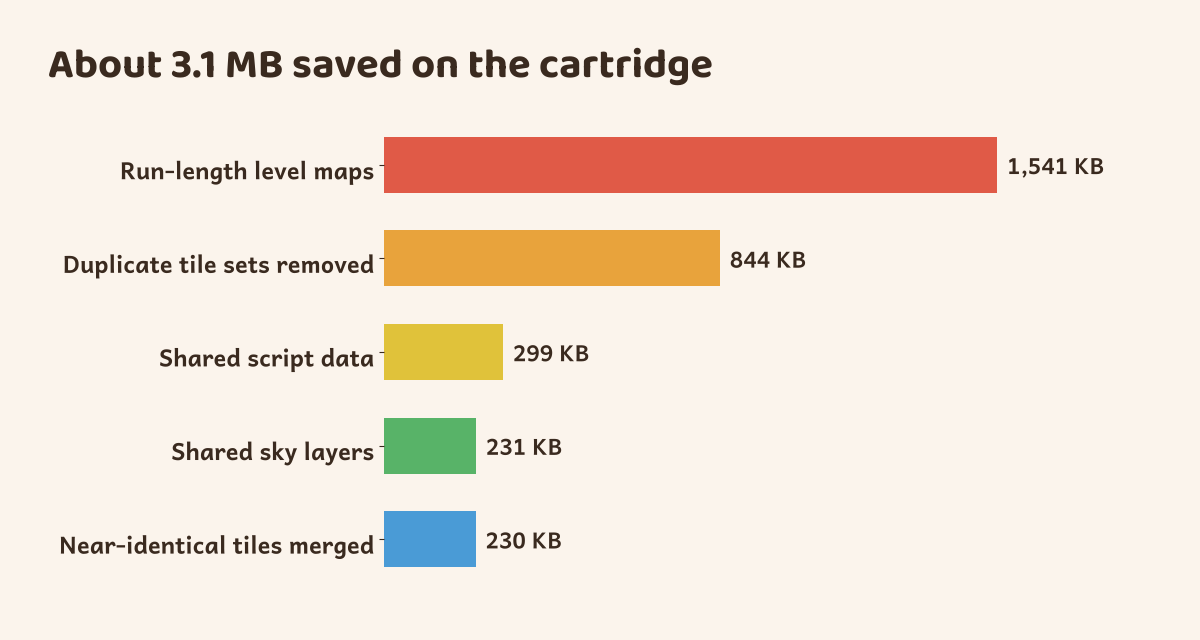
Huey 2.0 roughly triples the number of rooms, so I went looking for space. The biggest win was the level maps. They now store runs like "twelve grass tiles in a row" instead of listing every tile, and they're unpacked one row at a time as the camera scrolls. Standard compression would have needed tens of kilobytes of RAM to unpack, and I don't have that to spare. Run-length maps need none, and they saved 1.5 MB.

I also found tile sets that were stored twice, sky layers that several rooms could share, and level scripts that were exact copies of each other. Each of those is stored once now.

Last, I went after background tiles that were nearly identical, only a few pixels apart. I reviewed the merges myself to make sure none of the art changed in a way you'd notice. That freed about 7,000 tiles across the game's rooms and leaves each room more space for new art.

Sprites have their own limits. Only the frame of Huey you're looking at sits in video memory, and the next one gets swapped in each frame. Big boss frames are packed without their empty tiles. Together this keeps the game well inside its 32 MB cartridge, with room left to grow.

The Rain Forest flower layer before and after merging near-identical tiles. The two look the same.
Bar chart of cartridge space saved: run-length level maps 1,541 KB, duplicate tile sets 844 KB, shared script data 299 KB, shared sky layers 231 KB, near-identical tiles merged 230 KB
GameplayDesign

Four verbs, every power

Every power in Huey grows out of four verbs: run, jump, fight and float. Here is the map I drew to keep them all straight.

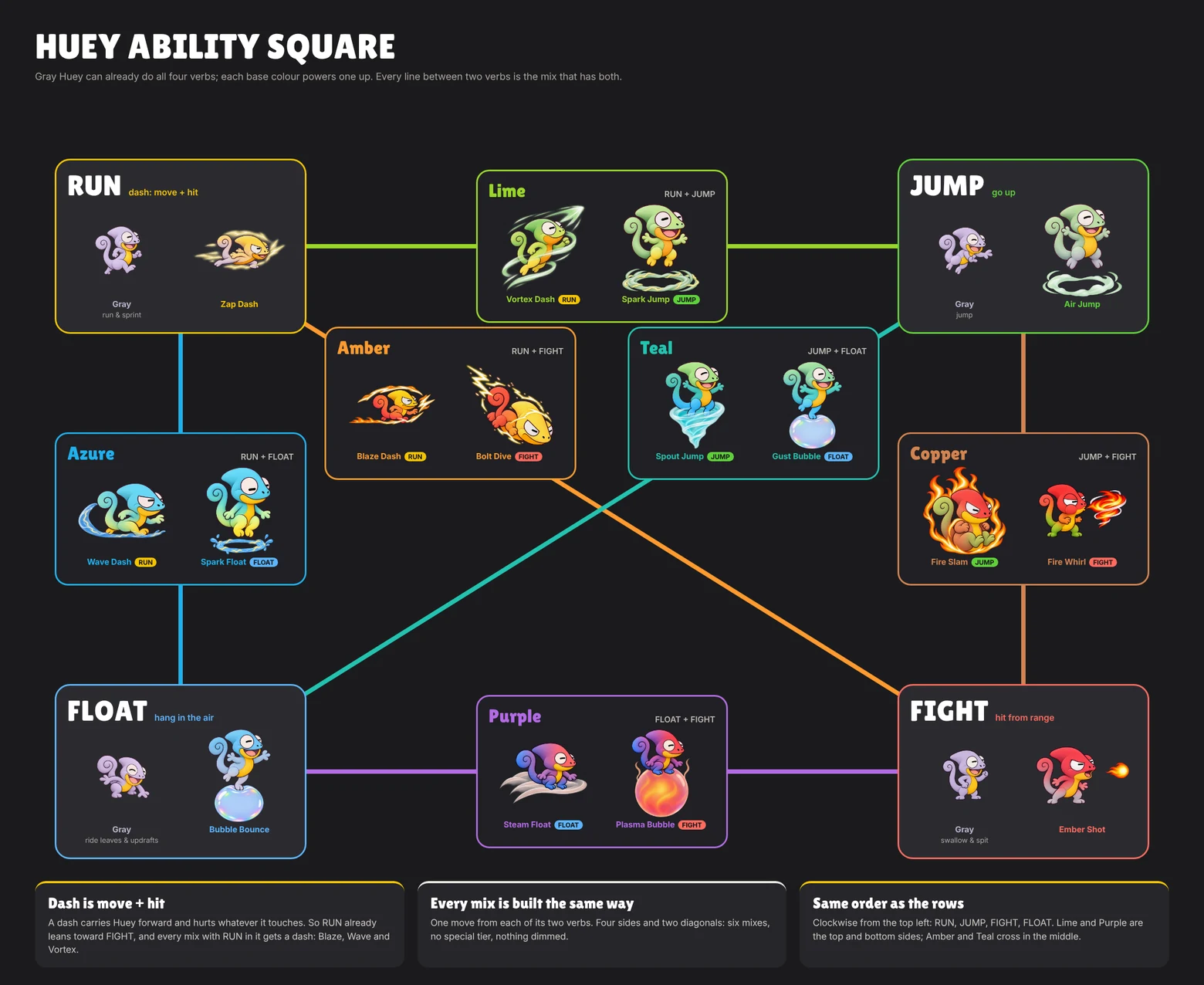
Huey has a lot of powers now, so I drew a map to keep them straight. Everything starts from four verbs: run, jump, fight and float. Gray Huey can already do all four with a little help from the world around him, like his tongue swing when he needs speed.

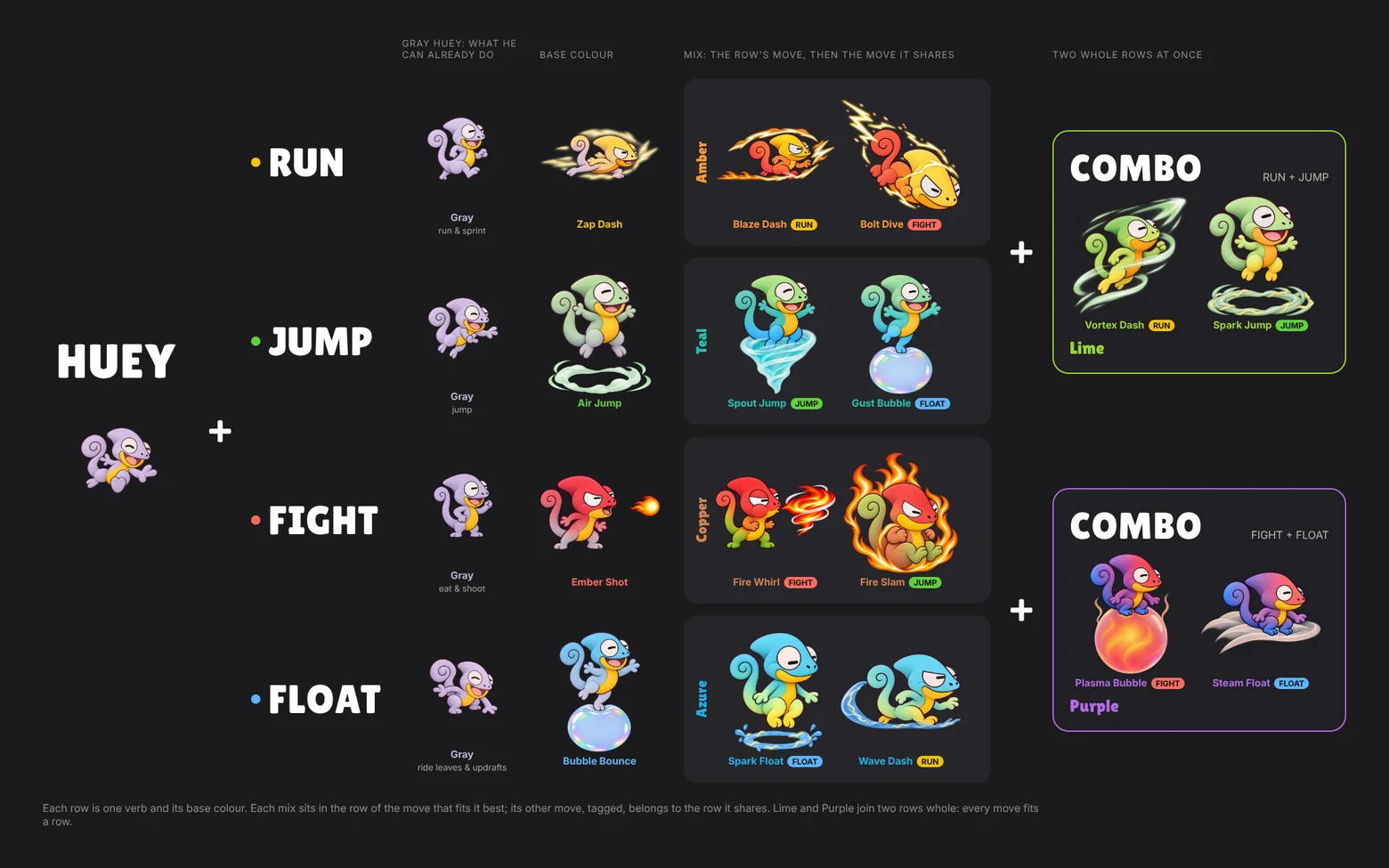
Each base color powers up one verb. Yellow runs with Zap Dash, green jumps with Air Jump, red fights with Ember Shot, and blue floats with Bubble Bounce. Blue is the first color you find, and the first level teaches Bubble Bounce within a few seconds of starting.

Mixing two colors pairs their verbs, with one move for each. Amber runs and fights with Blaze Dash and Bolt Dive. Teal jumps and floats with Spout Jump and Gust Bubble. Copper jumps and fights with Fire Slam and Fire Whirl. Azure runs and floats with Wave Dash and Spark Float. Purple fights and floats with Plasma Bubble and Steam Float. Lime runs and jumps with Vortex Dash and Spark Jump.

A few rules came out of drawing it. A dash counts as moving and hitting at the same time. Lime and purple are the strongest mixes on purpose, because they are the last ones you get. And if you take a hit and lose your colors, you fall back on gray Huey's verbs, so you always have a way forward.

The same ability map in a square layout, showing every color and its moves
A map of Huey's powers: the four verbs, the base color that powers up each one, and the six color mixes with their two moves each
ArtMusicHardware

The tools behind Huey

A look at my setup: GBA Studio, Aseprite, Tiled, my own sound scripts, test bots and a flash cart.

Here's a look at the setup I use to make Huey. The game is built with GBA Studio, with a good amount of custom code on top for things the engine doesn't do on its own, like the scanline color blend, the music player and streaming level maps in as the camera scrolls.

Pixel art gets drawn and finished in Aseprite. Each biome has a reusable tile kit, so levels are built from shared pieces and one-off tiles are rare. Levels are laid out in Tiled, and a build script converts the maps into the format the game reads.

Music and sound effects come from my own synthesizer scripts written in Python. Each song is written as code and rendered for the GBA's sound channels, which makes it easy to tweak a melody and rebuild.

For playing, I use the mGBA emulator on my Mac day to day and test on my phone too, but milestones go onto my own Game Boy Advance through a flash cartridge. Emulators miss some timing problems, and one music glitch this month only showed up on the hardware.

Then there are the test bots. Before a build counts as a release, it goes through a full automatic check on my Mac. Bots play every level and boss from start to finish, random-input testing hammers on dozens of rooms looking for soft-locks, and a performance sweep makes sure nothing drops below 60 frames per second. The full check takes about 20 minutes, and nothing gets released unless all of it passes.

Mitch's pixel art self-portrait
ArtDesign

A story told without words

Huey's journey climbs from waterfall cliffs up to the clouds, told only through the scenery.

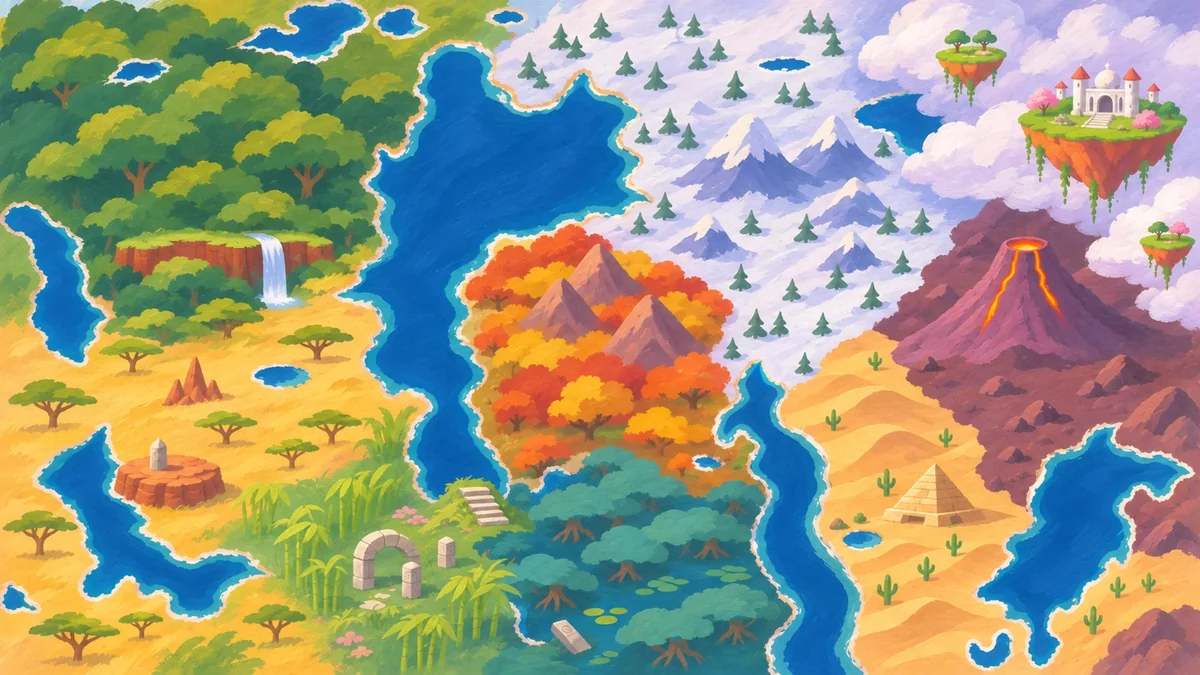
Huey tells its story through the scenery, with no text at all. The journey starts high on the waterfall cliffs and drops into a valley, then climbs through the mountains and up into the snow. From there it heads down through the desert and back up through the volcano into the clouds.
This week I drew storyboards for every biome. Each level tells a small story of its own, with landmarks you'll recognize as you pass through. Giant creatures, at least ten times Huey's size, move around in the background to show how small he is in a very big place. A few of them even help him along.

Keep an eye out for old ruins. Someone built them long before Huey showed up, and every biome leaves a clue.

Map of Huey's nine biomes, from the Rain Forest to the Sky Garden, joined by rivers and lakes
DesignLevels

Planning Huey 2.0

The whole game plays from start to finish. Now I'm rebuilding it into the version that ships.

I played through nearly the whole game this week. The core loop works and it's fun: eat fireflies, absorb their colors, find new ways through a level. The levels themselves still feel like prototypes, so I'm rebuilding them as Huey 2.0.

Levels are getting longer, with three rooms each, and every biome adds one new mechanic built around its color, like moving platforms, collapsing bridges, updrafts and dark rooms. I'm also redesigning the boss arenas so you move around each fight with purpose. When Huey mixes two colors, his body now shows both, with the first color on top fading into the second.

I swapped the order of two biomes, so the Savannas now come before the Bamboo Grove. The free demo will be the whole Rain Forest: three levels, the first boss and a bonus level.

Teal Huey, green on top fading to blue below, rides a waterspout
Hardware

Living in 32 KB of fast RAM

The GBA's fastest memory was nearly full. Here's how I got it back and how I keep it free.
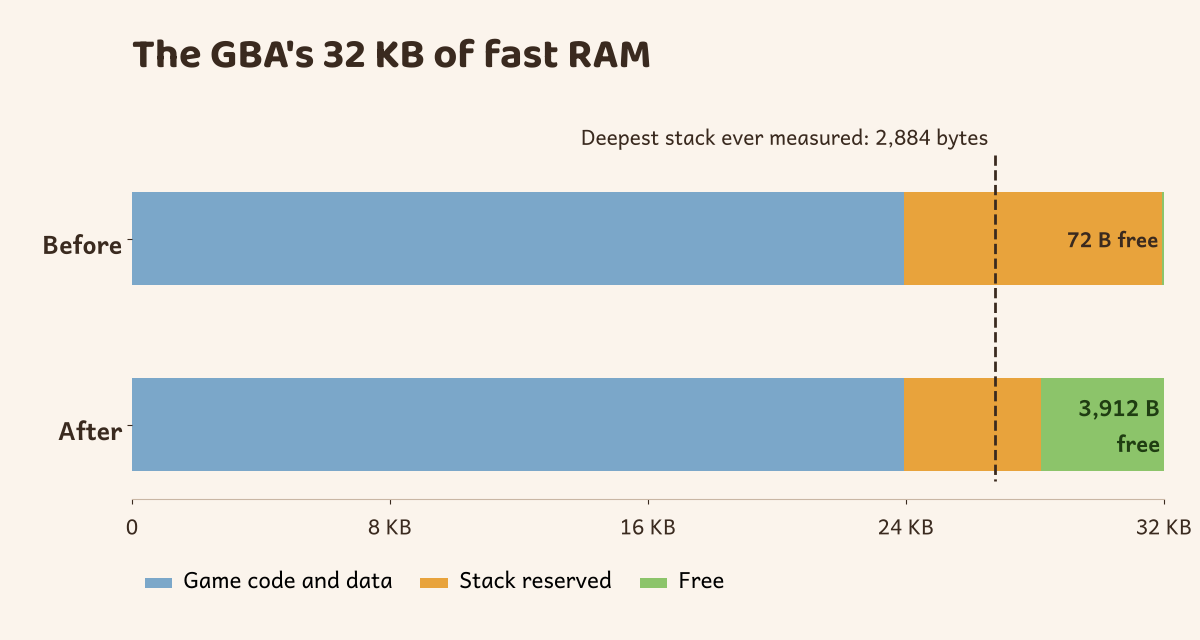
The Game Boy Advance has 32 KB of fast memory built into the processor. Code that runs every frame, like Huey's scanline effects, needs to live there to stay quick. By mid-November I had just 72 bytes of it free, and some new features had nowhere to go.

A big chunk was reserved for the stack, the scratch space the code uses while it runs. I didn't actually know how much of it the game needed, so I had my test bots record the deepest stack use while playing every level and every boss. The worst case was 2,884 bytes, and I'd set aside 8 KB. I cut the reservation to 4.25 KB, which still leaves a safety margin, and got almost 4 KB back.

Now every build has to keep at least 1 KB of fast RAM free or it fails the checks. New features go into the GBA's larger, slower memory unless I've measured that they need the speed. Code that only runs once in a while, like building the pause menu, moves out of fast memory too. Nothing in the game allocates memory on the fly, so every byte has a known home.

Chart of the GBA's 32 KB of fast RAM: before, 72 bytes were free; after shrinking the stack to fit its deepest measured use of 2,884 bytes, 3,912 bytes were free
BossesDesign

Rebuilding the boss fights

Every boss arena is being rebuilt around its biome's mechanic, so each fight works like a final exam.

With the Huey 2.0 plan in place, I went back through all nine boss fights. Each arena is now built from its biome's new mechanic, so the boss works like a final exam on everything that biome taught you. Every fight also uses your color mix and gives you a reason to use the tongue.

I set a few rules for every arena. Each one is a loop with no dead ends: a ground lane, a high lane, and the biome's mechanic connecting them. The boss sweeps one lane at a time, so there's always somewhere to move. Every opening to land a hit can be reached from at least two spots, so it never feels like one scripted move. Arenas are a screen and a half wide and tall, and the camera follows Huey, but the boss and its tells always stay on screen. Nothing hits you from off screen.

Fairness has hard numbers behind it. Every attack gives at least 40 frames of warning, and the window to hit back lasts at least 72 frames. The first time a boss uses an attack, it uses its slowest warning. When a boss gets angry, the arena turns its mechanic up, like faster leaves or a rising flood, and the boss gets one new attack.

Stalkstilt in the Bamboo Grove is a good example. Bait his stomp from the center, step onto a lift as his leg comes down, ride up while his foot is stuck, and air jump onto his head. The lifts are how you get up there, and his swipe punishes you for riding up at the wrong time.

The tightest limit in boss rooms is sprite memory, because big bosses use a lot of tiles. Packing boss frames without their empty tiles makes them about 30 percent smaller. Arena mechanics like crumbling bridges, mushroom caps and heat vents are built from background tiles and palette swaps wherever I can manage it, so they don't eat into the boss's share.

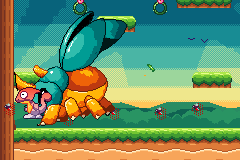
Huey faces Hornbuster in the Rain Forest
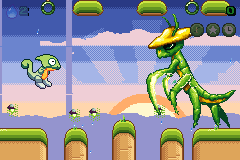
Green Huey faces Stalkstilt, a giant mantis in a straw hat, in the Bamboo Grove
DesignUI

Options for every player

Remappable controls, less flashing, a game speed setting, and art that never relies on color alone.

Huey is a game about colors, so I want it to work for players who see color differently and for anyone who needs a little more room to play. This week I approved a starter set of accessibility options. They're all available from the start, nothing is locked behind progress, and you can combine them however you like.

Control remapping lets you choose which button does what, with a hold-to-toggle setting for held moves like floating. Reduce flashing and shake turns off screen shake and bright full-screen flashes. Game speed runs the whole game at 100, 80 or 60 percent.

Game speed is the interesting one technically. It runs fewer logic ticks per second and leaves the physics values alone, so every jump lands in exactly the same spot at every speed. My test bots play the levels at each speed to make sure every route still works.

The biggest piece is a design rule more than a setting. Every bug color and every mix has to read by shape as well as color, so colors like red and green can be told apart by players with red-green colorblindness, which affects about 1 in 12 men. New art gets checked in grayscale and through a colorblind filter before it goes in. Huey's two-color blend helps too, because you can read the order of his colors by position, top and bottom.

None of these options affect your rank, medals or score, and nothing marks your results. I also cut one idea: unlimited air moves. It broke the game so badly that you didn't have to try.

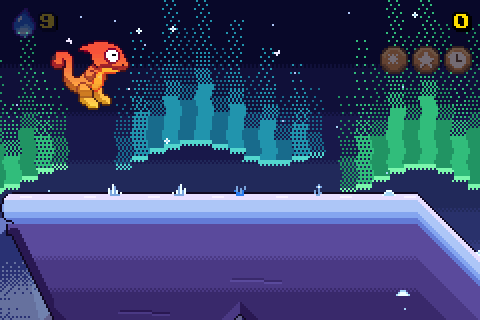
Amber Huey on a snowy ledge, red on top fading to yellow below
ArtNews

Box art and a first trailer

Huey has a box cover in the style of a classic GBA game, and a first trailer.

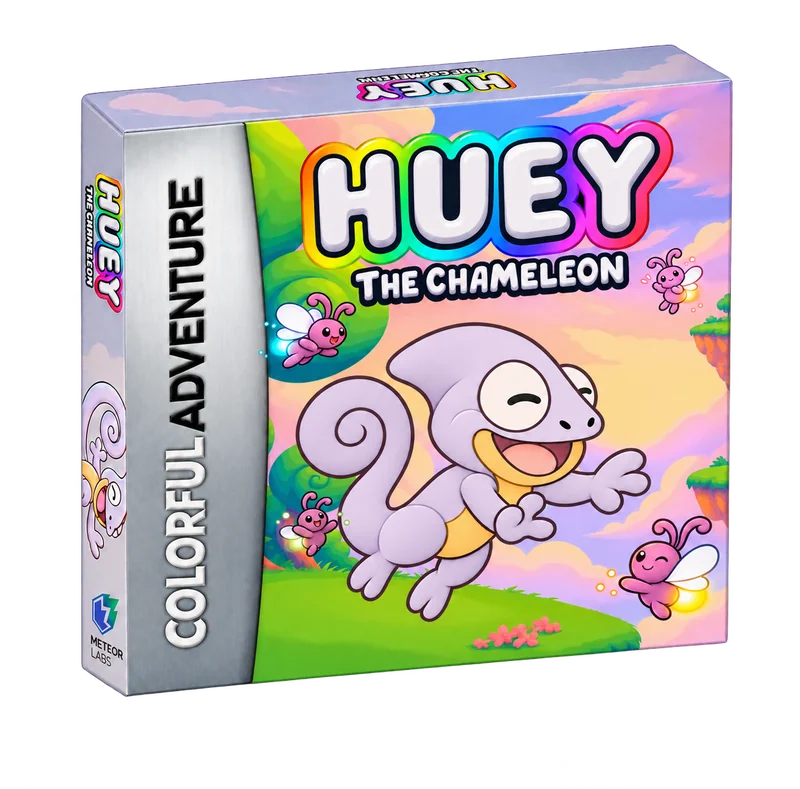
I wanted the box to look like the GBA boxes I grew up with: bright, simple and easy to spot on a shelf. Huey is gray on the cover because gray is how he starts every adventure. The sky behind him comes from the game's final biome.

I also cut a first trailer from footage of the game running at full speed. You can watch it on the website.

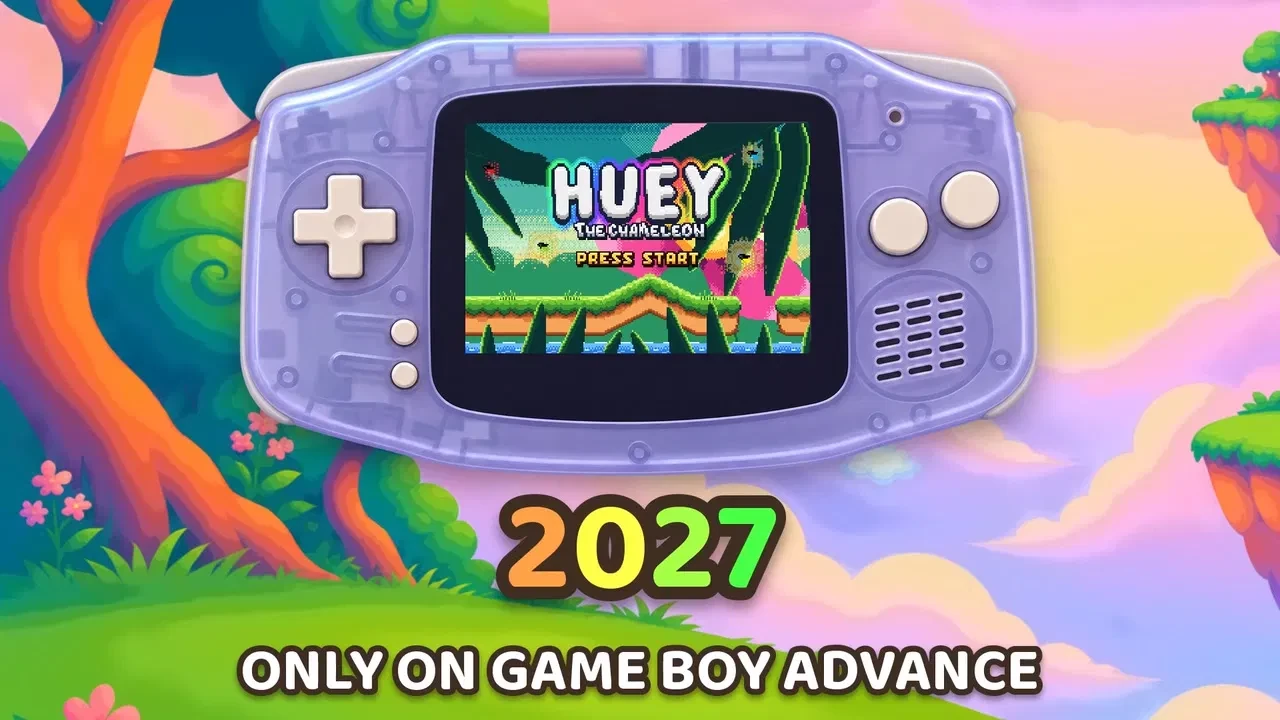
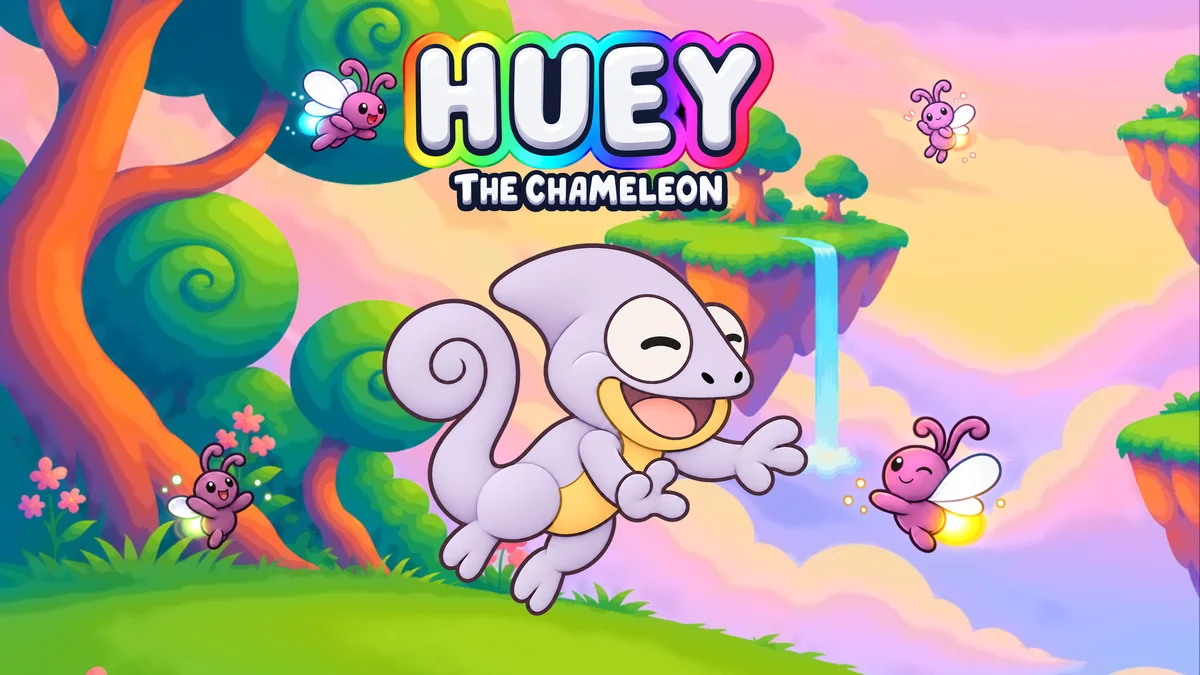
A still from the Huey trailer: a Game Boy Advance showing the game, with 2027 and Only on Game Boy AdvanceHuey key art: gray Huey leaps across floating islands chasing fireflies
The Huey the Chameleon Game Boy Advance box, with gray Huey and fireflies on the cover
HardwareNews

Alpha, played on original hardware

Every biome, boss and menu works on a Game Boy Advance. Huey's alpha is done.

Huey hit alpha this week. I played the whole build on my own Game Boy Advance from a flash cartridge, didn't find a single bug, and tagged it as the alpha.

Every build also has to pass a full set of automatic checks before I call it done. Test bots play every level and every boss, measure the frame rate and watch for anything that freezes or breaks. The game has to hold 60 frames per second the whole time you're playing.

Next up is cleaning up the code and art, then starting on Huey 2.0.

Blue Huey walks under a rainbow on the floating islands of the Sky Garden
News

Getting ready for Kickstarter

I'm planning a Kickstarter to fund physical Game Boy Advance cartridges.

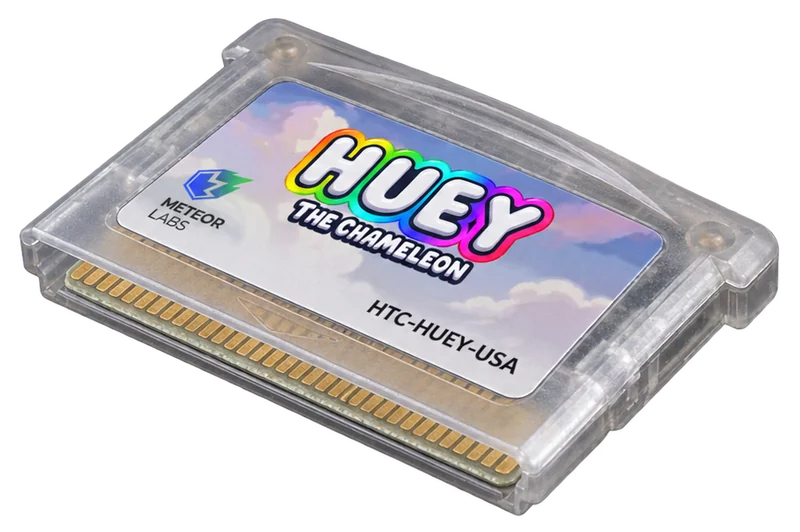
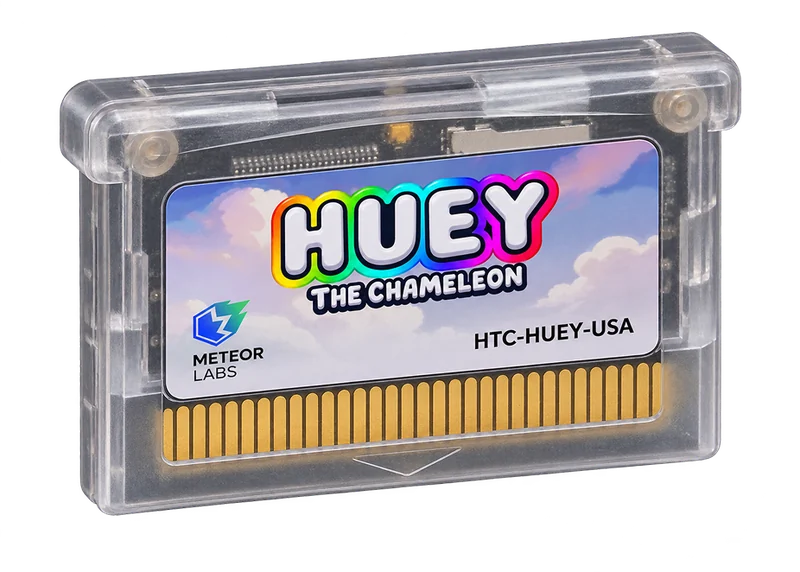
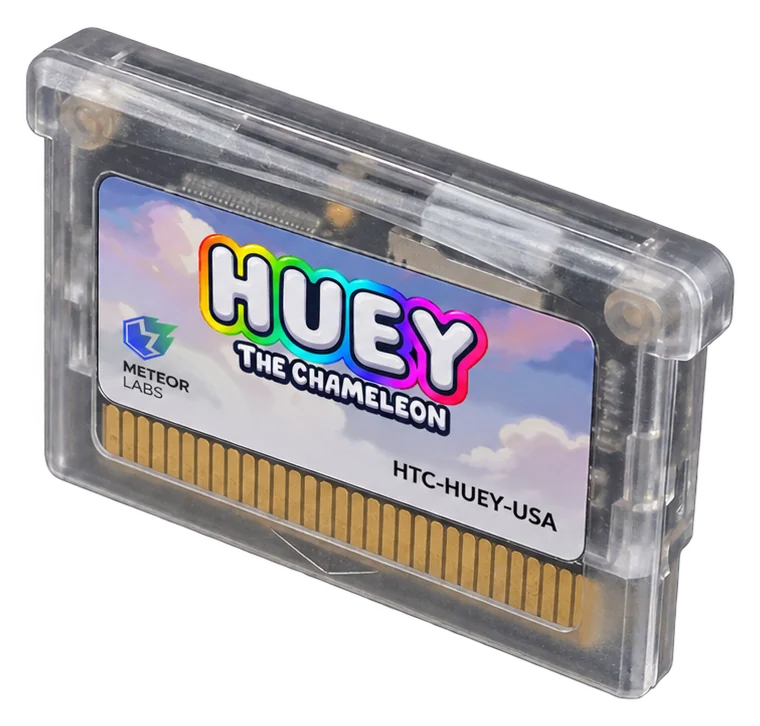
I'm getting ready to launch a Kickstarter for physical Game Boy Advance cartridges. Each one is made by hand, with a custom case, label and box.

The game will be nearly finished when the campaign starts, so you'll know exactly what you're backing. A free demo comes first, so you can play Huey before you decide. A Steam version is the first stretch goal.
A concept of the clear Huey cartridge, seen from the sideA concept of the clear Huey cartridge, seen from the front
A concept of the Huey Game Boy Advance cartridge
UIBosses

Polish week

Bubble menus, three save files, boss entrances and a lot of small touches.
This week went to the small things that make a game feel finished. The menus are now round, bubbly panels. A new Settings page lets you adjust the music, sound and ambience volume along with the text speed, and there are three save files.

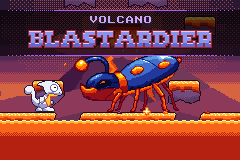
Every boss now makes an entrance, then its name slams onto the screen with a flash and a shake. When you win, Huey dances to the beat on the results screen. Tall grass, leaf piles and snow banks burst apart as he runs through them.

I also fixed a couple of things that bugged me in testing. Touching an enemy now knocks Huey back without freezing the action, and holding Down no longer blocks a jump.

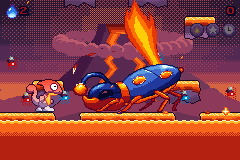
Red Huey faces Blastardier as the volcano erupts behind himHuey faces Skeeterbog under the root arches of the Mangrove
Blastardier's name card slams onto the screen as the Volcano boss fight begins
Bosses

Every biome gets a boss

Nine bug bosses, each beaten with a different color power.

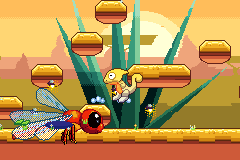
Every biome ends with a big bug. Hornbuster, Zipwing, Stalkstilt, Skeeterbog, Mothgloom, Frostpede, Pitmaw and Blastardier are all in the game, plus one more I'm keeping secret for now.

Each boss is weak to one color power, and the fireflies in its arena give you the colors you need. Every fight has its own version of the biome's music, and it speeds up when the boss gets angry.

Once all nine were in, I spent a full pass making sure every fight holds a steady 60 frames per second.

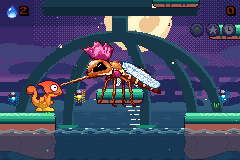
Yellow Huey faces Zipwing, a giant dragonfly, in the SavannasBlue Huey faces Mothgloom beside a giant mushroomHuey jumps above Frostpede in its icy bowl in Snowy PeaksHuey faces Pitmaw in its sand pit in the Desert
Levels

Five challenge stages

A sled run, a rising flood, a lava climb, a sandstorm and wind gusts.

Some biomes have a challenge stage that breaks the usual rules. In Snowy Peaks you ride a sled downhill and can only jump. In the Mangrove a flood rises behind you, and in the Volcano the lava climbs in steps. The Desert sends a sandstorm after you, and in the Sky Garden the wind shoves you around.

These stages are short and intense. They sit between the normal levels and the boss as a change of pace from exploring.

LevelsArt

Nine biomes

From the Rain Forest to the Sky Garden, every biome now has its first level.

Huey's adventure crosses nine biomes: Rain Forest, Savannas, Bamboo Grove, Mangrove, Mountains, Snowy Peaks, Desert, Volcano and Sky Garden. This week each one got its first playable level.

Every biome has its own weather, like drifting seeds, rain, blowing sand, embers and snow. Big foreground plants tower over the screen so you feel bug-sized, and each biome has its own song.

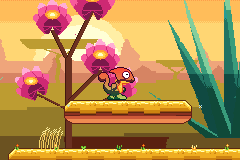
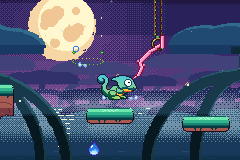
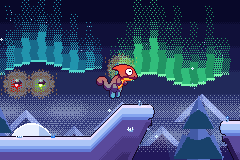
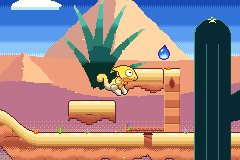
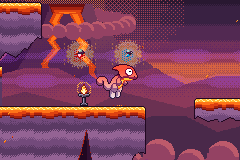
Copper Huey on a flowering acacia ledge in the SavannasAmber Huey swings between giant bamboo stalksTeal Huey swings under the moon in the MangroveHuey jumps under the aurora in Snowy PeaksYellow Huey in the Desert beside a giant cactusRed Huey leaps between lava rock ledges
Gameplay

Mixing colors

Eat two fireflies and Huey mixes their colors into a brand new power.

This is the big idea behind Huey. When he eats a firefly he absorbs its color and the power that comes with it: red, blue, green or yellow. Eat a second color and the two mix into one of six new powers.

Colors also change how Huey gets around. Red can wade through lava and blue can swim, and the first level already has an alternate route for each color. Getting hit costs you your newest color, so playing well is how you hold on to your powers.

Amber Huey dives down in a spiral of lightningCopper Huey slams down in a burst of firePurple Huey floats on a cloud of steamLime Huey dashes inside a swirl of windAzure Huey runs through an electric wave
Gameplay

Swinging by the tongue

Huey's tongue grabs swing points, so now he can swing across gaps.

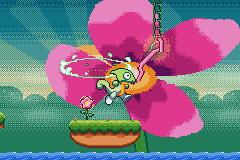
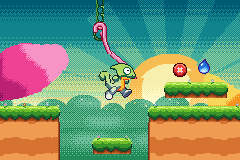
Huey's tongue does more than eat bugs. Aim it at a swing point and he'll swing across the gap. Let go at the right moment for a short hop or a long flight, or hold Up to climb the tongue and jump off the top.

I also tuned how Huey runs and jumps. He jumps higher now, and running at full speed for a moment builds into a sprint. You can still jump for a few frames after running off a ledge, and a jump pressed just before landing still counts. Those two small windows, usually called coyote time and a jump buffer, make the controls feel a lot more forgiving.

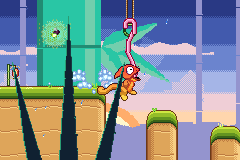
Huey swings from a ring beside a giant pink flowerGreen Huey hangs from his tongue above the Rain Forest
Gameplay

Scores, ranks and medals

Every level now ends with a score, a rank and three medals to find.

Finishing a level now brings up a results card with your time, your score and a rank from C up to S. Chaining pickups and stomps builds a combo multiplier, and standing still too long resets it.

Every level hides three medals. One sits out in plain sight, one is tucked away, and one is for beating the par time. Your best results are saved.

Checkpoints sit about a third and two thirds of the way through each level, so one mistake doesn't send you all the way back to the start.

Music

A soundtrack made for the GBA

Huey has its own music player, a song for every biome and a little voice.

The first music I had sounded harsh, because every note restarted on every beat. So I wrote Huey its own small music player, where notes can hold and fade out smoothly. Sound effects also rise in pitch when you collect things in a row.

Every biome has its own song, with drums played through the GBA's sample channel. The title screen gets a slow, relaxed theme, and songs fade into each other instead of cutting off. Huey even shouts his own name when the logo lands.

All of the music and sound comes out of my own synthesizer scripts, so every song, drum hit and sound effect is generated from code and tuned for the GBA's sound channels.

Green Huey on a grassy ledge in the Mountains
HardwareArt

Locked at 60 frames per second

One hardware setting took the game from 52 to a steady 60 frames per second.

My first art test put a layered Rain Forest on the GBA, with the sky, the far trees, the flowers, the ground and the leaves in front of Huey each scrolling at their own speed. It ran at 52 frames per second.

The fix turned out to be one setting. The GBA lets a game choose how long the processor waits on each cartridge read, and mine was still on the slowest option. Switching to the standard faster timing got me a steady 60, and every build since then measures its own frame rate.

I also built the opening. There's no separate title screen. Palm leaves frame the logo, and when you press Start they slide apart and Huey runs straight into the first level.

The Huey title screen, framed by palm leaves
News

Huey hatches

I designed Huey back in 2011. This month he's finally a Game Boy Advance game.

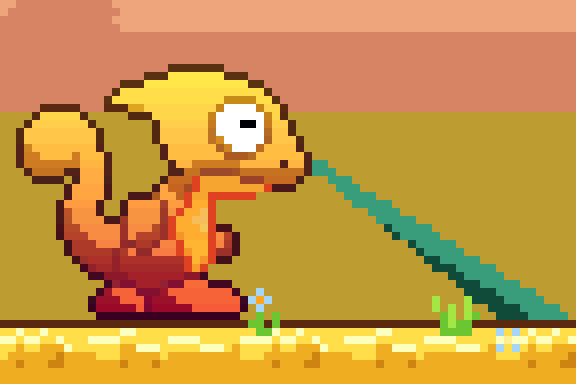
I designed Huey and his world back in 2011, but the game never quite came together. The Game Boy Advance is my favorite system, and this month Huey finally runs on one.

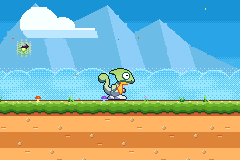
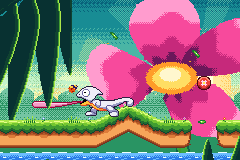
The first playable room is simple. Gray Huey runs, jumps, stomps a Kicket and restarts when he falls into a pit. It's a small start, and the rest of this log covers what came next.

Gray Huey stretches his tongue toward a red firefly beside a giant flower
Changelog110 changes over 22 days · about 236 hours of my time

Every day's changes, newest first. Numbers like r84 are build numbers.

Nov 25Enemies 2.0 planned: the seven original bugs become the core cast for the whole game, and each biome adds its own…12 h · 8 changes
  • Enemies 2.0 planned: the seven original bugs become the core cast for the whole game, and each biome adds its own
  • Stomp & shoot: small bugs you can stomp can also be eaten and shot back out, and eating one with full cheeks swaps it in with a puff of air
  • One big-bug moment per level on the main path; enemy limits raised to 6 types per biome, 4 per level and 3 per room
  • Rain Forest rebuilt for 2.0: 1-1 Hatchling Falls redesigned, and 1-2 Petal Swing, 1-3 Canopy Dash and the 1-B bonus Leafbearer Line built and playable
  • Hornbuster's new arena and fight in the game, ending in a boss medal struck in gold from his own head
  • The whole Rain Forest, boss and bonus included, now plays start to finish as one demo build
  • Meteor Labs splash plays the full space jingle; fixes for pool water, cave lighting, game over and the Continue music
  • Accounts set up: YouTube, Bluesky and X as @hueychameleon, an itch.io page and a Meteor Labs Kickstarter
Nov 24Huey's body shows his colors as a smooth top-to-bottom blend, made by rewriting his palette on every scanline…12 h · 8 changes
  • Huey's body shows his colors as a smooth top-to-bottom blend, made by rewriting his palette on every scanline
  • Move lab tested on a Game Boy Advance, and the new control scheme approved: A moves, R attacks, B tongue, L spit
  • Each button can be used once per jump, so a dash can chain into an air move
  • Dashes and dives can be steered a little mid-move; small ledge assist added
  • Tongue swing kept as gray Huey's own fast way to move
  • Moves named: green's Air Jump, yellow's Zap Dash, Teal's Spout Jump, and Cobalt renamed Azure
  • Every color now powers up one of four verbs: run, jump, fight or float
  • Near-duplicate background tiles merged to free up room for new art
Nov 23Level maps stored as runs and unpacked as the camera scrolls (1.5 MB saved)…12 h · 4 changes
  • Level maps stored as runs and unpacked as the camera scrolls (1.5 MB saved)
  • Duplicate sky layers and level scripts stored once (about 530 KB saved)
  • Website copy pass, with the enemy section renamed "Big Bad Buggies"
  • Dev log automation planned
Nov 22Website home page and press kit built…16 h · 4 changes
  • Website home page and press kit built
  • Orange becomes yellow; the red and yellow mix is now called Amber
  • Color stacking rules settled: each base color has one move, and each mix has an attack and an air move
  • Huey's one-line pitch chosen: "A color-mixing adventure platformer for the Game Boy Advance"
Nov 21Storyboards drawn for every biome: one journey by altitude, big background creatures and clues to mysterious builders…16 h · 3 changes
  • Storyboards drawn for every biome: one journey by altitude, big background creatures and clues to mysterious builders
  • Every level gets its own look, and rooms within a level are varied
  • Code reorganized into clean modules before any Huey 2.0 work starts
Nov 20Played nearly the whole game: the core loop works, and the levels get rebuilt for Huey 2.0…16 h · 4 changes
  • Played nearly the whole game: the core loop works, and the levels get rebuilt for Huey 2.0
  • Huey 2.0 levels will be longer, with three rooms each
  • The demo will be all of the Rain Forest, including its boss and bonus level
  • Savannas now comes before Bamboo Grove
Nov 19Huey 2.0 design: one new mechanic per biome, with moving platforms, collapsing bridges, updrafts and dark rooms…12 h · 8 changes
  • Huey 2.0 design: one new mechanic per biome, with moving platforms, collapsing bridges, updrafts and dark rooms
  • Spit moves to L, and swallowed bugs become tools for hitting switches
  • A mixed-color Huey shows both colors as a smooth gradient
  • Boss arenas redesigned so the fights flow
  • Ability stars chosen: THICK SKIN, HEARTY, GOBBLE and POWER SHOT
  • Starter accessibility options approved; they never affect rank or medals
  • Music slowdown glitch fixed
  • Every build must keep at least 1 KB of fast RAM free
Nov 18Box cover nearly final, with the sky taken from the game's last biome…12 h · 3 changes
  • Box cover nearly final, with the sky taken from the game's last biome
  • The new sprite set becomes the only version of Huey and the bugs
  • Stalkstilt gets a close-range swipe with a clear wind-up
Nov 17Box art direction set: bright and simple like a classic GBA box, with gray Huey on the cover12 h · 1 change
  • Box art direction set: bright and simple like a classic GBA box, with gray Huey on the cover
Nov 16Alpha tagged (r164) after a full playthrough on a Game Boy Advance with no defects found…12 h · 4 changes
  • Alpha tagged (r164) after a full playthrough on a Game Boy Advance with no defects found
  • Decided to run a Kickstarter as a launch campaign, with Steam as a stretch goal
  • Marketing plan and website wireframe drafted; hueythechameleon.com registered
  • Stack trimmed from 8 KB to 4.25 KB after measuring every level and boss, freeing almost 4 KB of fast RAM
Nov 15Huey starts each level with 2 dew (r160)…16 h · 5 changes
  • Huey starts each level with 2 dew (r160)
  • Checkpoints now restore Huey's color
  • Fixed a respawn bug that could put Huey inside the ground (r161)
  • Every build now runs the full automatic check before release
  • Duplicate tile sets removed from the cartridge (844 KB saved)
Nov 14Title logo letter spacing tuned (r158)…8 h · 2 changes
  • Title logo letter spacing tuned (r158)
  • Design review of every ability and level after a full playthrough
Nov 13The tongue only grabs swing points in the air, and eating a nearby bug comes first (r156)…8 h · 4 changes
  • The tongue only grabs swing points in the air, and eating a nearby bug comes first (r156)
  • Huey can roam boss arenas freely; an off-screen boss shows an edge arrow
  • Every level uses a lower camera, so water and lava stay in view (r157)
  • Work starts on a new, more detailed sprite set for Huey
Nov 12Bubble-style menus and a Settings page for music, sound, ambience and text speed (r149)…8 h · 6 changes
  • Bubble-style menus and a Settings page for music, sound, ambience and text speed (r149)
  • Three save files, a game over screen and the Meteor Labs splash (r150)
  • Tall boss arenas, and each boss makes an entrance
  • Huey dances on the results screen; a celebration plays after each boss
  • Holding Down no longer blocks a jump (r152)
  • Run-through grass, leaves, sand and snow in every biome (r153)
Nov 11Every enemy touch knocks Huey back without freezing him (r142)…8 h · 5 changes
  • Every enemy touch knocks Huey back without freezing him (r142)
  • Four new levels and redrawn enemy sprites (r143)
  • Wider boss arenas with extra platforms (r144)
  • Level audit: swing points moved within reach, and no corner can trap Huey (r145, r146)
  • Boss name card that slams onto the screen (r148)
Nov 10Every boss fight holds a flat 60 fps (r125)…8 h · 7 changes
  • Every boss fight holds a flat 60 fps (r125)
  • New boss art in all nine fights (r126)
  • Ability stars you can switch on from the pause menu (r127)
  • Duntle rolls its ball along floors and slopes (r128)
  • Four levels per biome, with seven new levels (r130, r132)
  • New world objects: cracked ice, fuses, rope bridges, orb gates and breakable ceilings (r136)
  • One menu system for pause, results and game over (r139)
Nov 9"Huey!" voice, goal fanfare and ability jingle (r102)…8 h · 5 changes
  • "Huey!" voice, goal fanfare and ability jingle (r102)
  • Boss themes with faster enraged versions (r104)
  • Five challenge stages: Sled Run, Rising Flood, Lava Climb, Sandstorm and Wind Gusts (r108 to r113)
  • All nine bosses in the game (r107 to r120)
  • New swimming and sled frames for Huey (r123)
Nov 8Lava pools; red Huey wades through them (r82)…8 h · 7 changes
  • Lava pools; red Huey wades through them (r82)
  • Alternate routes in 1-1 for each color (r83)
  • Color mixes: any two base colors combine into a new power (r84)
  • First level of every biome (r86), with weather, ambience and giant foreground plants (r88 to r93)
  • Drums on the GBA's sample channel, and a song for every biome (r94, r95)
  • New Rain Forest song and a calm title theme (r97, r98)
  • Songs fade into each other (r100)
Nov 7Par times and a time medal (r62)…8 h · 7 changes
  • Par times and a time medal (r62)
  • Splashes, ski dust and checkpoint sprouts (r63)
  • Huey opens his mouth for the tongue and spit (r69)
  • Eye expressions: angry, hurt and squint (r72)
  • Pause screen and full-screen menus (r75, r77)
  • Climb the tongue during a swing (r80)
  • Ghost Spore: briefly pass through enemies (r81)
Nov 6Flowing waterfalls, mosaic transitions and swimming (r19 to r23)…8 h · 8 changes
  • Flowing waterfalls, mosaic transitions and swimming (r19 to r23)
  • Huey's own music player and 12 sound effects
  • Coyote time and a jump buffer (r27)
  • Scores, combo multiplier, ranks, medals and saving (r31 to r33)
  • Levels can be any length; 1-1 grows four times longer with climbs and ski slopes (r43 to r47)
  • Checkpoints and a game over screen (r50, r51)
  • Smooth tongue swings (r52 to r54)
  • Higher jump and a momentum sprint (r56, r57)
Nov 5Art target for every biome set from the Rain Forest concept…8 h · 6 changes
  • Art target for every biome set from the Rain Forest concept
  • Layered parallax and foreground leaves over Huey
  • Cartridge timing fix: 52 to a steady 60 frames per second
  • Title opening with palm leaves and the "power colors" logo
  • Dew drops work as health
  • The first three Rain Forest levels built
Nov 4First playable room: run, jump, stomp a Kicket, fall and restart8 h · 1 change
  • First playable room: run, jump, stomp a Kicket, fall and restart